
Type – Mammal
Diet – Herbivorous

Location – The species is seriously endangered and mostly extinct from its original range of distribution
The species’ range has contracted markedly during the last half of the century. Little is known about the current distribution of the isolated remnant populations, also as a result of their capacity for long seasonal migrations. Formerly ranging from Egypt to Tunisia and Morocco , this species has been exterminated in the northern part of the Sahara and is currently present only from Mauritania to Sudan but it is considered to be nearly extinct in the wild. It still occurs in Chad , Mali , Mauritania , Niger , Sudan , and is extinct in Algeria , Egypt , Libya , Morocco and Tunisia population has been reintroduced.
Habitat – The addax inhabits arid regions. They can live in extremely arid areas, with less than 100 mm annual rainfall. It also inhabits deserts with tussock grasses and succulent thorn scrub Cornulaca. In the day the addax huddles together in shaded areas, and on cool nights rests in sand hollows. These practices help in dissipation of body heat and saving water by cooling the body through evaporation.

Conservation – The last hundred years has seen addax population plummet due to merciless hunting and the advent of modern weapons and desert-going vehicles. Today, the addax can only be found in two small populations, one in the Tin Toumma desert of eastern Niger and the other, across the border, in Chad’s Eguey-Bodélé region.
Currently, it is not possible to ensure the survival of wild addax in Niger and in the border with Chad because of insecurity and logistics constraint due to huge and remote addax distribution areas.
Addax can also be found in their historical range in semi-captive conditions in Tunisia and Morocco.
An action plan for the remaining wild populations of addax in Niger and Chad, has been drafted by Sahara Conservation, ZSL, IUCN/SSC Antelope Specialist Group, CMS, Noé, Niger and Chadian national agencies. It highlights three main priorities to save this species:
Establishing the fate of the largest addax population in Termit & Tin Toumma – whether it has been dispersed or greatly reduced, and locating remaining animals – is an urgent priority, as is establishing the extent and frequency of movement between sites. Monitoring programmes for populations of addax should be continued and expanded where feasible, using standardised protocols. It is also important to expand the current genetic research on the wild and captive populations of both species.
Prevent the loss of more animals from the wild by ensuring effective protection from poaching at key sites and also extending protection to habitat, notably by establishing undisturbed zones away from water wells and livestock.

Keep strong and effective links with the populations on site. Working with local communities who share the habitat and use the same pastures is essential to long-term success of conservation programs. Several agreements in Niger have been signed by the traditional local and administrative authorities, including the Déclaration de Dolé (2007), Déclaration de Dougoulé (2010). The Doungoumi Declaration (December 2016) even contains a commitment to protect wildlife and includes collaboration on removal of unauthorized wells: this agreement could serve as a model for elsewhere in the region.
Lifecycle – Females are sexually mature at 2 to 3 years of age and males at about 2 years. Breeding occurs throughout the year, but it peaks during winter and early spring. In the northern Sahara, breeding peaks at the end of winter and the beginning of spring; in the southern Sahara, breeding peaks from September to October and from January to mid-April. Each estrus bout lasts for one or two days.

In a study, the blood serum of female addaxes was analyzed through immunoassay to know about their luteal phase. Estrous cycle duration was of about 33 days. Each female underwent an anovulatory period lasting 39 to 131 days, during which there was no ovulation. Anovulation was rare in winter, which suggested the effect of seasons on the estrous cycle.
Gestation period lasts 257–270 days (around nine months). Females may lie or stand during the delivery, during which one calf is born. A postpartum estrus occurs after two or three days. The calf weighs 5 kg at birth and is weaned at 23–29 weeks old.
The life span of the addax is up to 19 years in the wild, which can be extended to 25 years under captivity.
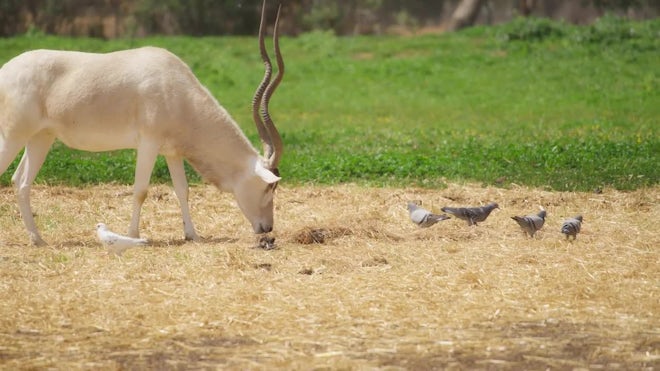
Food – The addax lives in desert terrain where it eats grasses and leaves of what shrubs, leguminous herbs and bushes are available. Primarily a grazer, its staple foods include Aristida, Panicum, and Stipagrostis, and it will only consume browse, such as leaves of Acacia trees in the absence of these grasses. It also eats perennials which turn green and sprout at the slightest bit of humidity or rain. The addax eats only certain parts of the plant and tends to crop the Aristida grasses neatly to the same height. By contrast, when feeding on Panicum grass, the drier outer leaves are left alone while it eats the tender inner shoots and seeds. These seeds are important part of the addax’s diet, being its main source of protein. The addax is amply suited to live in the deep desert under extreme conditions. It can survive without free water almost indefinitely, because it gets moisture from its food and dew that condenses on plants. Scientists think the addax has a special lining in its stomach that stores water in pouches to use in times of dehydration. It also produces highly concentrated urine to conserve water.
Predators – Due to its slow movements, the addax is an easy target for predators such as humans, lions, leopards, cheetahs and African wild dogs. Caracals, servals and hyenas attack calves. The addax is normally not aggressive, though individuals may charge if they are disturbed.
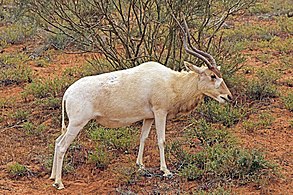
Biology – The addax is a spiral-horned antelope. Male addaxes stand from 105 to 115 cm at the shoulder, with females at 95 to 110 cm. They are sexually dimorphic, as the females are smaller than the males. The head and body length in both sexes is 120 to 130 c, with a 25 to 35 cm long tail. The weight of males varies from 100 to 125 kg, and that of females from 60 to 90 kg.

The coloring of the addax’s coat varies with the season. In the winter, it is greyish-brown with white hindquarters and legs, and long, brown hair on the head, neck, and shoulders. In the summer, the coat turns almost completely white or sandy blonde. Their head is marked with brown or black patches that form an ‘X’ over their noses. They have scraggly beards and prominent red nostrils. Long, black hairs stick out between their curved and spiralling horns, ending in a short mane on the neck.
The horns, which are found on both males and females, have two to three twists and are typically 55 to 80 cm in females and 70 to 85 cm in males, although the maximum recorded length is 109.2 cm. The lower and middle portions of the horns are marked with a series of 30 to 35 ring-shaped ridges. The tail is short and slender, ending in a puff of black hair. The hooves are broad with flat soles and strong dewclaws to help them walk on soft sand. All four feet possess scent glands.
The addax closely resembles the scimitar oryx, but can be distinguished by its horns and facial markings. While the addax is spiral-horned, the scimitar oryx has decurved 127 cm long horns. The addax has a brown hair tuft extending from the base of its horns to between its eyes. A white patch, continuing from the brown hair, extends until the middle of the cheek. On the other hand, the scimitar oryx has a white forehead with only a notable brown marking, a brown lateral stripe across its eyes. It differs from other antelopes by having large, square teeth like cattle and lacking the typical facial glands.
The addax has 29 pairs of chromosomes. All chromosomes are acrocentric except for the first pair of autosomes, which are submetacentric. The X chromosome is the largest of the acrocentric chromosomes, and the Y chromosome is medium-sized. The short and long arms of the pair of submetacentric autosomes correspond respectively to the 27th and 1st chromosomes in cattle and goats. In a study, the banding patterns of chromosomes in addax were found to be similar to those in four other species of the subfamily Hippotraginae.
Videos/Documentaries
All About Addax – 2 minutes
Learning About Addax Antelope – 5 minutes
Bringing the Zoo to You – Addax & Oryx – 7 minutes
Meet the critically endangered addax – 4 minutes
Addax – In 1 Minute! 🦌 One Of The Most Endangered Animals – 1 minutes
Addax or White Antelope: A Critically Endangered Species – 2 minutes
Addax – 4 minutes
A Desert Denizen Looks for a New Lease on Life – 1 minutes
Survival in the Sahara | The Remarkable Journey of the Addax – 1 minutes
13 Endangered Addax Facts – 4 minutes
The Addax: The Desert Survivor with Unique Adaptations – 4 minutes
More Information
https://en.wikipedia.org/wiki/Addax
https://www.britannica.com/animal/addax-antelope
https://nationalzoo.si.edu/animals/addax
 Maxine the Magnificent