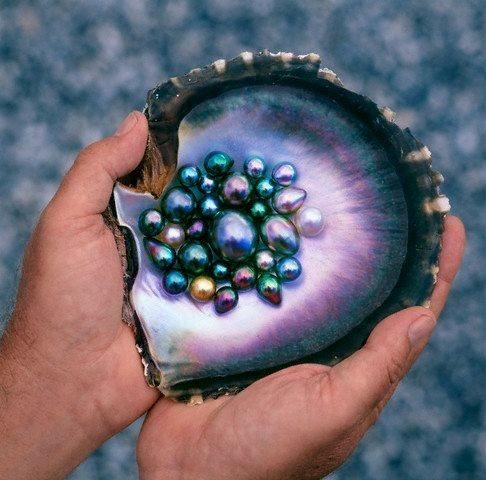
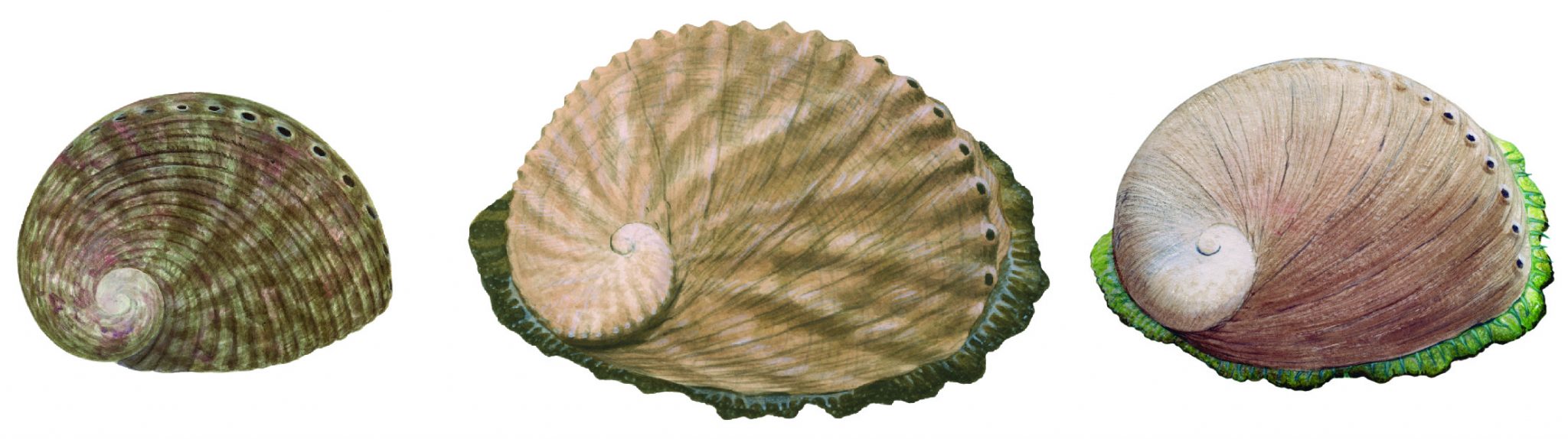
Background – Along with Conch snails and Melo melo, Abalones are also one of the few gastropods that are capable of producing pearls. As with pearls that are formed by a mollusc such as an oyster, an Abalone’s pearls are made by depositing thousands of layers of an organic substance called nacre. Abalones are snail-like marine mollusks native to warm and temperate waters around the world. Considered a food delicacy and collected for their shells, they occasionally produce natural pearls of great beauty. In recent years, declining wild populations have led to restrictions on commercial fishing. This spurred development of abalone farming.
Location – Abalone pearl culturing began in New Zealand and the US in the 1990’s. The world’s largest farm is located on the coast of northern California.

Culturing – After being spawned and raised for three years, the animal receive a single nucleus. The pearl growth period is one or two years. The results so far include blister pearls and mabés measuring about 10 to 15 millimeters. Efforts are under way to find reliable methods for producing whole pearls.
Abalone pearls are extemely difficult to culture. The Abalone animal, Haliotis (there are 7 identified species in North America, and a few different species in Europe, Asia, Australia and New Zealand) unfortunately are hemophiliacs- meaning that they will bleed to death if cut. Normal nucleation techniques just do not work with the Abalone.
In the early 1980’s Dr. Fankboner from Pacific Pearl Culture, British Columbia, successfully experimented with culturing the Abalone Blister pearls (earlier attempts were made in the late 1800’s with lackluster results), and it is also true that Eyris Pearl Co. of New Zealand has made some wonderful advances in culturing Abalone Mabe or blister pearls. Their pearls are extraordinarily colored deep blue and green tones.
Appearance – Abalone pearls often display a metallic luster with vivid color and orient. The body color spectrum includes red, orange, yellow, green, blue, magenta, pink, gold, bronze and silver. Sometimes several of these colors create an opal-like mixture in a single pearl.
 Maxine the Magnificent