
Type – Gastropod Molluscs
Diet – Herbivorous
Location – The haliotid family has a worldwide distribution, along the coastal waters of every continent, except the Pacific coast of South America, the Atlantic coast of North America, the Arctic, and Antarctica.
The majority of abalone species are found in waters, off the coasts of New Zealand, South Africa, Australia, Western North America, and Japan.
Habitat – The shell of the abalone is exceptionally strong and is made of microscopic calcium carbonate tiles stacked like bricks. Between the layers of tiles is a clingy protein substance. When the abalone shell is struck, the tiles slide instead of shattering and the protein stretches to absorb the energy of the blow.
Conservation – White abalone were intensely harvested for commercial and recreational purposes during the 1970s. Fishing quickly peaked and crashed as the abalone became increasingly scarce. The subsequently low densities of abalone have resulted in repeated reproductive failure, making it unlikely that the species will recover on its own. Abalone are also threatened by global warming, ocean acidification, and bacterial and parasitic infections.
Lifecycle – Abalone reproduce by releasing their eggs and sperm into the surrounding water. For fertilization to occur, spawners need to be within three feet of a member of the opposite sex. Only one day after fertilization, abalone eggs hatch into larvae, which float for a week or two. The larvae eventually metamorphose into the adult form and settle to the ocean floor. White abalone live for an estimated 30 to 40 years
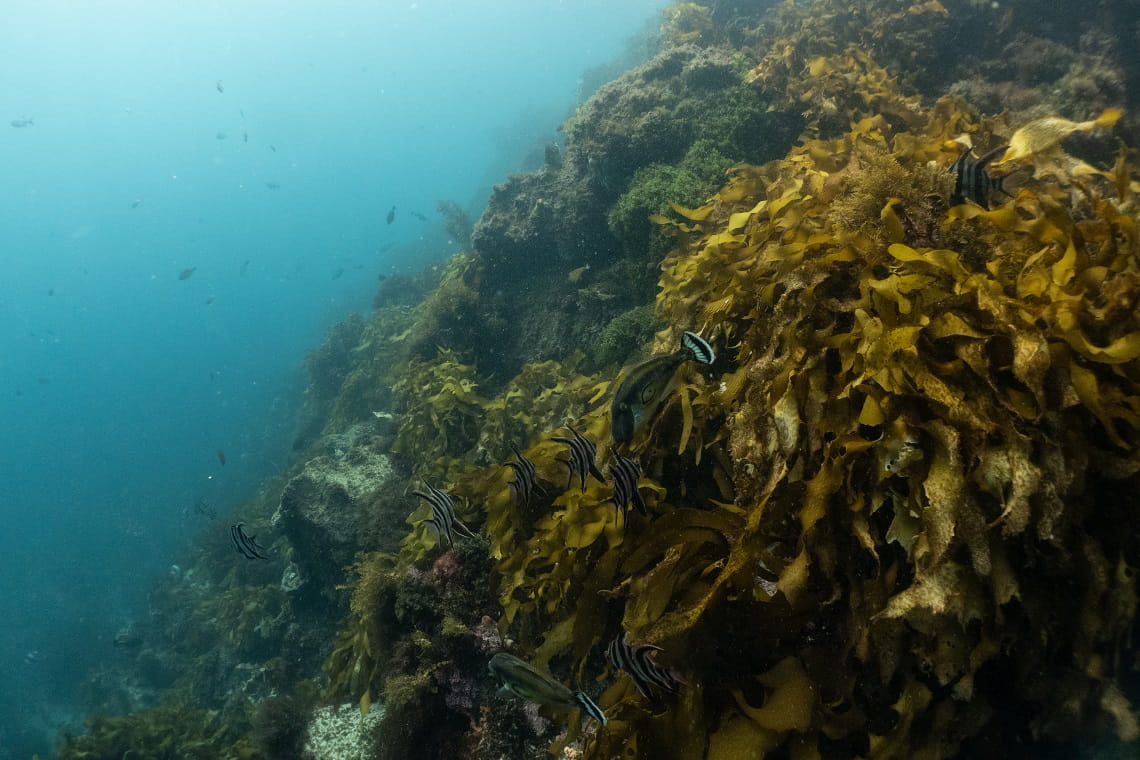
Food – Abalone have a rasping tongue, called a radula, to graze on algae, though they catch most food by raising their shell and clamping down on algae as it floats by. As a result, they are therefore found in greatest numbers on those parts of a reef where bits of broken-off algae tend to collect.
Biology – Most abalone vary in size from 20 mm to 200 mm. The largest species, Haliotis rufescens, reaches 300 mm.
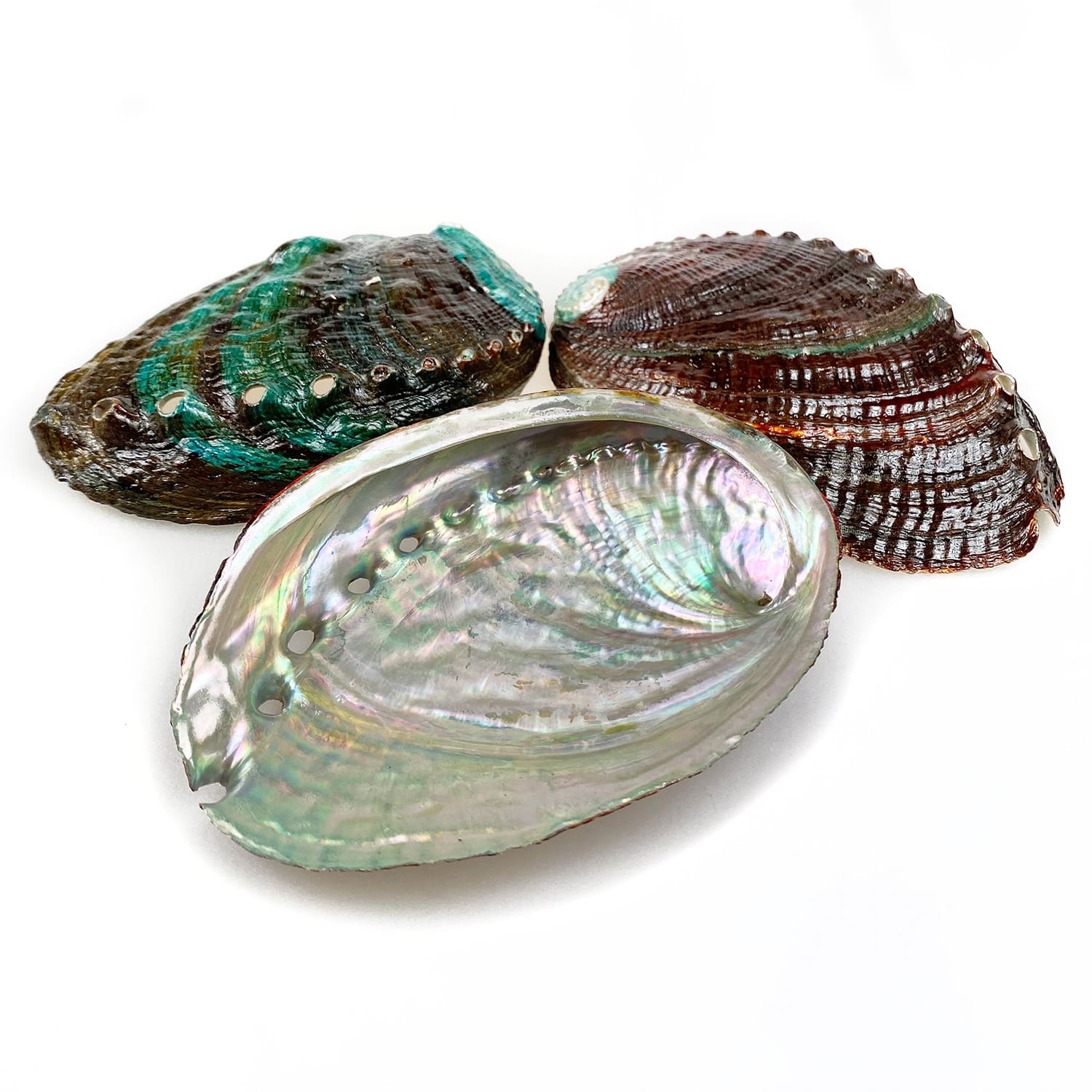
The shell of abalones is convex, rounded to oval in shape, and may be highly arched or very flattened. The shell of the majority of species has a small, flat spire and two to three whorls. The last whorl, known as the body whorl, is auriform, meaning that the shell resembles an ear, giving rise to the common name “ear shell”. The exterior of the shell is striated and dull.
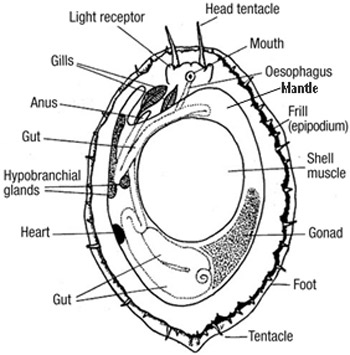
A mantle cleft in the shell impresses a groove in the shell, in which are the row of holes characteristic of the genus. These holes are respiratory apertures for venting water from the gills and for releasing sperm and eggs into the water column. They make up what is known as the selenizone, which forms as the shell grows. This series of eight to 38 holes is near the anterior margin. Only a small number is generally open. The older holes are gradually sealed up as the shell grows and new holes form.
The animal has fimbriated head lobes and side lobes that are fimbriated and cirrated. The radula has small median teeth, and the lateral teeth are single and beam-like. They have about 70 uncini, with denticulated hooks, the first four very large. The rounded foot is very large in comparison to most molluscs. The soft body is coiled around the columellar muscle, and its insertion, instead of being on the columella, is on the middle of the inner wall of the shell. The gills are symmetrical and both well developed.
These snails cling solidly with their broad, muscular foot to rocky surfaces at sublittoral depths, although some species such as Haliotis cracherodii used to be common in the intertidal zone. Abalones reach maturity at a relatively small size. Their fecundity is high and increases with their size, laying from 10,000 to 11 million eggs at a time. The spermatozoa are filiform and pointed at one end, and the anterior end is a rounded head.
Species – The number of species that are recognized within the genus Haliotis has fluctuated over time, and depends on the source that is consulted. The number of recognized species ranges from 30 to 130.
SPECIES/LOCATION
Haliotis alfredensis South Africa
Haliotis arabiensis Off Yemen and Oman
Haliotis asinina Philippines; Indonesia; Australia; Japan; Thailand; Vietnam
Haliotis australis New Zealand
Haliotis brazieri Eastern Australia
Haliotis clathrata Seychelles; Comores; Madagascar; Mauritius; Kenya
Haliotis coccoradiata Eastern Australia
Haliotis corrugata California, USA; Baja California, Mexico
Haliotis cracherodii California, USA; Baja California, Mexico
Haliotis cyclobates Southern Australia
Haliotis dalli Galapagos Islands, western Colombia
Haliotis discus Japan; South Korea
Haliotis dissona Australia; New Caledonia
Haliotis diversicolor Japan; Australia; Southeast Asia
Haliotis drogini Cocos Island
Haliotis elegans Western Australia
Haliotis exigua Japan
Haliotis fatui Tonga Mariana Islands
Haliotis fulgens California, USA; Baja California, Mexico
Haliotis geigeri São Tomé and Príncipe Islands
Haliotis gigantea Japan
Haliotis glabra Philippines; Vietnam
Haliotis iris New Zealand
Haliotis jacnensis Japan; Nicobar Islands; Ryukyu Islands; Pacific Islands;
Haliotis kamtschatkana Western North America
Haliotis laevigata South Australia; Tasmania
Haliotis madaka Japan; South Korea
Haliotis mariae Oman; Yemen
Haliotis marmorata Liberia; Ivory Coast; Ghana
Haliotis melculus Australia (New South Wales, Queensland)
Haliotis midae South Africa
Haliotis mykonosensis Greece; Turkey; Tunisia
Haliotis ovina Thailand; Vietnam; southern part of the Pacific Ocean; Andaman Islands; Maldives; Ryukyu Islands
Haliotis papulata Australia; Papua New Guinea; Philippines; Sri Lanka; Thailand
Haliotis parva South Africa; Angola
Haliotis planata Ryukyu Islands; Sri Lanka; Indonesia; Fiji; Andaman Sea
Haliotis pourtalesii Eastern USA; Gulf of Mexico; Eastern South America; northern Colombia
Haliotis pulcherrima Polynesia
Haliotis queketti Eastern Africa
Haliotis roei Australia
Haliotis rubiginosa Lord Howe Island
Haliotis rubra Southern and Eastern Australia
Haliotis rufescens Western North America
Haliotis rugosa South Africa; Madagascar; Mauritius; Red Sea
Haliotis scalaris Southern and Western Australia
Haliotis semiplicata Western Australia
Haliotis sorenseni California, USA; Baja California, Mexico
Haliotis spadicea South Africa
Haliotis speciosa Eastern South Africa
Haliotis squamosa Southern Madagascar
Haliotis stomatiaeformis Malta; Sicily
Haliotis supertexta Japan; Sao Tome
Haliotis thailandis Andaman Sea
Haliotis tuberculata Ireland (introduced); Channel Islands; Azores; Canary Islands; Madeira ; Brittany; Great Britain
Haliotis unilateralis Gulf of Aqaba; East Africa; Seychelles;
Haliotis varia Mascarene Basin; Red Sea; Sri Lanka; Western Pacific;
Haliotis virginea New Zealand; Chatham Islands; Auckland Islands; Campbell Island
Haliotis walallensis Western North America
Videos
Facts: The Abalone – 2:34 minutes
WHITE GOLD // South Africa’s most valuable snail (Abalone Documentary) – 24:04 minutes
Abalone divers working in the path of great white sharks | Southern Ocean Live – 5:38 minutes
Abalone Diving Tasmania – 79:36 minutes
Divers Search For Precious Abalone In Shark Infested Waters | Abalone Wars – 8:08 minutes
Abalone – The Deadly Harvest – 26:03 minutes
Abalone Facts: a SNAIL with HOLES?! 🐌 Animal Fact Files – 3:48 minutes
More Information
https://en.wikipedia.org/wiki/Abalone
https://www.britannica.com/animal/abalone
https://www.montereybayaquarium.org/animals/animals-a-to-z/abalone
https://kids.kiddle.co/Abalone
https://australian.museum/learn/animals/molluscs/blacklip-abalone
 Maxine the Magnificent