Type – Mammal
Diet – Insectivore carnivore
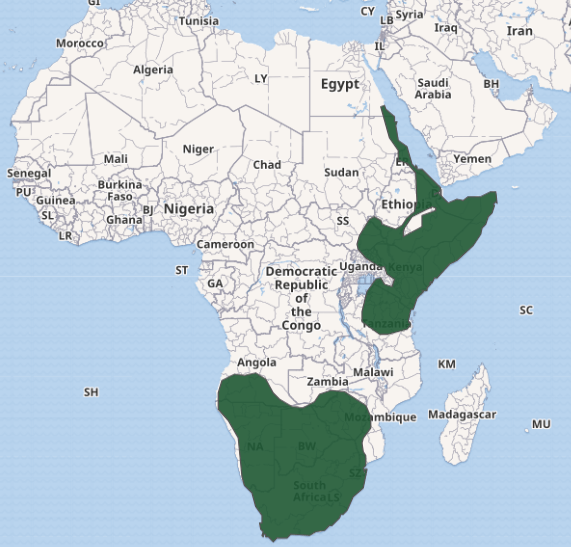
Location – [Africa] There are two distinct populations: one in Southern Africa, and another in East and Northeast Africa. The species does not occur in the intermediary miombo forests.
Habitat – Aardwolves live in open, dry plains and bushland, avoiding mountainous areas. Due to their specific food requirements, they are found only in regions where termites who depend on dead and withered grass are most populous in heavily grazed grasslands and savannahs, including farmland. For most of the year, aardwolves spend time in shared territories consisting of up to a dozen dens, which are occupied for six weeks at a time.
Conservation – The aardwolf has not seen decreasing numbers and is relatively widespread throughout eastern Africa.

Lifecycle – The breeding season varies depending on location, but normally takes place during autumn or spring. In South Africa, breeding occurs in early July. During the breeding season, unpaired male aardwolves search their own territory, as well as others, for a female to mate with. Dominant males also mate opportunistically with the females of less dominant neighboring aardwolves, which can result in conflict between rival males.
Gestation lasts between 89 and 92 days, producing two to five cubs (most often two or three) during the rainy season (November–December), when termites are more active. They are born with their eyes open, but initially are helpless, and weigh around 200–350 g. The first six to eight weeks are spent in the den with their parents. The male may spend up to six hours a night watching over the cubs while the mother is out looking for food. After three months, they begin supervised foraging, and by four months are normally independent, though they often share a den with their mother until the next breeding season. By the time the next set of cubs is born, the older cubs have moved on. Aardwolves generally achieve sexual maturity at one and a half to two years of age.


Food – The aardwolf feeds primarily on termites. Their technique consists of licking them off the ground as opposed to the aardvark, which digs into the mound. They locate their food by sound and also from the scent secreted by the soldier termites. An aardwolf may consume up to 250,000 termites per night using its long, broad, sticky tongue. They are also known to feed on other insects and larvae, and, some sources mention, occasionally eggs, small mammals and birds, but these constitute a very small percentage of their total diet.
Predators – Aardwolves are not fast runners nor are they particularly adept at fighting off predators. Therefore, when threatened, the aardwolf may attempt to mislead its foe by doubling back on its tracks. If confronted, it may raise its mane in an attempt to appear more menacing. It also emits a foul-smelling liquid from its anal glands.
Biology – The aardwolf resembles a much smaller and thinner striped hyena, with a more slender muzzle, black vertical stripes on a coat of yellowish fur, and a long, distinct mane down the midline of the neck and back. It also has one or two diagonal stripes down the fore- and hind-quarters, along with several stripes on its legs.

The aardwolf is about 55 to 80 cm long, excluding its bushy tail, which is about 20–30 cm long, and stands about 40 to 50 cm tall at the shoulders. An adult aardwolf weighs approximately 7–10 kg, sometimes reaching 15 kg. The aardwolf is the smallest extant member of the Hyaenidae family. The front feet have five toes each, unlike the four-toed hyena. It does still have canines, but, unlike other hyenas, these teeth are used primarily for fighting and defense. Its ears are large and are very similar to those of the striped hyena.
Behavior – Aardwolves are shy and nocturnal, sleeping in burrows by day. They will sometimes during the winter, become diurnal feeders. This happens during the coldest periods as they then stay in at night to conserve heat.
They are primarily solitary animals, though during mating season they form monogamous pairs which occupy a territory with their young. If their territory is infringed upon by another aardwolf, they will chase the intruder away. The territory is marked by both sexes, as they both have developed anal glands from which they extrude a black substance that is smeared on rocks or grass. An aardwolf pair may have up to 10 dens. Their dens are usually abandoned aardvark, springhare, or porcupine dens. They cover their excrement with sand.

Videos/Documentaries
Exploring the Enigmatic Aardwolf: Nature’s Lesser-Known Predator – 3 minutes
Aardwolf Facts: the HYENA you’ve NEVER HEARD OF | Animal Fact Files – 4 minutes
Meet the Aardwolf – 1 minutes
Aardwolf: The World’s Cutest Hyena – 7 minutes
Aardwolf – Animal of the Week – 3 minutes
Aardwolf – Cincinnati Zoo – 1:30 minutes
More Information
https://en.wikipedia.org/wiki/Aardwolf
https://www.newworldencyclopedia.org/entry/Aardwolf
https://www.britannica.com/animal/aardvark
https://www.nationalgeographic.com/animals/mammals/facts/aardwolves
 Maxine the Magnificent