
Type – Mammal
Diet – Insectivore
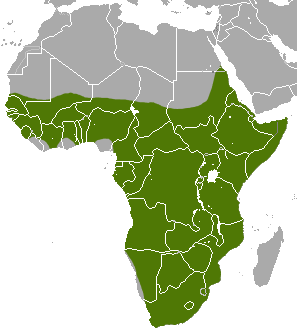
Location – [Africa] They are present throughout sub-Saharan Africa all the way to South Africa with few exceptions including the coastal areas of Namibia, Ivory Coast, and Ghana. They are not found in Madagascar.
Habitat – Savannas, grasslands, woodlands and bushlands where its food e.g. ants and termites are available. They spend the daylight hours in dark burrows to avoid the heat of the day.
Aside from digging out ants and termites, the aardvark also excavates burrows in which to live, which generally fall into one of three categories: burrows made while foraging, refuge and resting location, and permanent homes. Temporary sites are scattered around the home range and are used as refuges, while the main burrow is also used for breeding. Main burrows can be deep and extensive, have several entrances and can be as long as 13 meters. The aardvark changes the layout of its home burrow regularly, and periodically moves on and makes a new one. The old burrows are an important part of the African wildlife scene. As they are vacated, they will be inhabited by smaller animals like the African wild dog, ant-eating chat, Nycteris thebaica and warthogs. Other animals that use them are hares, mongooses, hyenas, owls, pythons, and lizards. Without these refuges many animals would die during wildfire season. Only mothers and young share burrows; however, the aardvark is known to live in small family groups or as a solitary creature. If attacked in the tunnel, it will escape by digging out of the tunnel thereby placing the fresh fill between it and its predator, or if it decides to fight it will roll onto its back, and attack with its claws. The aardvark has been known to sleep in a recently excavated ant nest, which also serves as protection from its predators

Conservation – There are no definitive counts because of their nocturnal and secretive habits; however, their numbers seem to be stable overall. Research suggests that aardvarks may be particularly vulnerable to alterations in temperature caused by climate change. Droughts negatively impact the availability of termites and ants, which comprise the bulk of an aardvark’s diet. Aardvarks can live for up to 23 years in captivity and handle it well.

Lifecycle – Aardvarks pair only during the breeding season. Aardvarks are polygynous, which means that one male mates with a number of females. Due to their solitary and territorial behavior, these animals socialize only when mating. In northern African populations, births usually occur in October-November, while those in South Africa produce offspring in May-July. They have a gestation period of seven months then one cub weighing around 1.7–1.9 kilograms is born. When born, the young has flaccid ears and many wrinkles. It will nurse off each teat in succession. After two weeks, the folds of skin disappear and after three weeks, the ears can be held upright. After 5–6 weeks, body hair starts growing. It is able to leave the burrow to accompany its mother after only two weeks and eats termites at 9 weeks, and is weaned between three – four months. At six months of age, it is able to dig its own burrows, but it will often remain with the mother until the next mating season, and is sexually mature from approximately two years of age.

Food – Aardvarks feed almost exclusively on ants and termites and the only fruit eaten by aardvarks is the aardvark cucumber. The cucumber and the aardvark have a symbiotic relationship as they eat the subterranean fruit, then defecate the seeds near their burrows, which then grow rapidly due to the loose soil and fertile nature of the area. The time spent in the intestine of the aardvark helps the fertility of the seed, and the fruit provides needed moisture for the aardvark. They don’t eat the African driver ant and red ants. An aardvark emerges from its burrow in the late afternoon or shortly after sunset, and forages over a considerable home range encompassing 10 to 30 kilometers. While foraging for food, the aardvark will keep its nose to the ground and its ears pointed forward, which indicates that both smell and hearing are involved in the search for food. They zig-zag as they forage and will usually not repeat a route for 5–8 days as they appear to allow time for the termite nests to recover before feeding on it again.

Predators – Predators include lions, leopards, cheetahs, African wild dogs, hyenas, and pythons. Aardvarks can dig fast or run in zigzag fashion to elude enemies, but if all else fails, they will strike with their claws, tail and shoulders, sometimes flipping onto their backs lying motionless except to lash out with all four feet. Sometimes, when pressed, aardvarks can dig extremely quickly.
Movement – The aardvark is known to be a good swimmer and has been witnessed successfully swimming in strong currents. It can dig a yard of tunnel in about five minutes, but otherwise moves fairly slowly. When leaving the burrow at night, they pause at the entrance for about ten minutes, sniffing and listening. After this period of watchfulness, it will bound out and within seconds it will be 10 meters away. It will then pause, prick its ears, twisting its head to listen, then jump and move off to start foraging.
Sound – The aardvark is a rather quiet animal. However, it does make soft grunting sounds as it forages and loud grunts as it makes for its tunnel entrance. It makes a bleating sound if frightened.

Biology – The aardvark is vaguely pig-like in appearance. Its body is stout with a prominently arched back and is sparsely covered with coarse hairs. The limbs are of moderate length, with the rear legs being longer than the forelegs. The front feet have four toes, while the rear feet have five toes. Each toe bears a large, robust nail which is somewhat flattened and shovel-like, and appears to be intermediate between a claw and a hoof.
An aardvark’s weight is typically between 60 and 80 kilograms and length is usually between 105 and 130 centimeters.
The aardvark is pale yellowish-grey in colour and often stained reddish-brown by soil.
The aardvark’s stomach has a muscular pyloric area that acts as a gizzard to grind swallowed food up, thereby rendering chewing unnecessary. Both sexes emit a strong smelling secretion from an anal gland. Its salivary glands are highly developed and almost completely ring the neck; their output is what causes the tongue to maintain its tackiness. The female has two pairs of teats in the inguinal region.
Videos/Documentaries
Secret Creatures: Africa’s earth pig, the Aardvark – 6:47 minutes
Can You Dig It? Meet Zola the Aardvark – 3:17 minutes
15 Cool Facts About Aardvarks | Fun Animal Facts For Kids – 2:37 minutes
Aardvark Facts: BIGGER than you think | Animal Fact Files – 4:05 minutes
Conservation: The Aardvark in Africa – 13:39 minutes
What Are The Parts of An Aardvark? | Animal Anatomy For Kids – 2:00 minutes
I’m an Aardvark – 2:00 minutes
What Exactly is Aardvark – 11 minutes
More Information
https://en.wikipedia.org/wiki/Aardvark
https://kids.nationalgeographic.com/animals/mammals/facts/aardvark
https://www.britannica.com/animal/aardvark
 Maxine the Magnificent